


How we met the artist:
'The encounter with David Connearn’s lines came through a somewhat unusual path. A client of the Contemporary Art Society wished to sell a series of five drawings by David. I was contacted as the gallery had a reputation for obsessive positions in the program - and fell in love on first sight, never having heard of David before. As simple as the initial concept of David’s drawings may be, the metaphors of a line never being like another line yet following the one before, links to life, days, years, patterns, earth stratifications, weaving, moving, breathing. Simply brilliant in execution, deeply philosophical in scale.' Patrick Heide
About:
David Connearn draws lines. For hours, days and weeks starting with a single line that he draws freehand and as straight as possible across the top of the page. He then retraces a second line just underneath that first one following its wandering path with all its imperfections. In doing so, each line errs and veers off, setting a new track for the next to continue to do so until the work is finished.
Once completed, the works release marks and patterns of rich texture reminiscent of waves, wrinkles and folds, textiles or even darkness. These are the result of converging or diverging lines, their diverse densities and varying rates of wear in the tinting strength of the pencil or ink. Alternating brighter and darker layers up to entire passages arise. This can extend beyond single works and even cover whole series of works in which the gradations of pencil or colour are continued.
Connearn’s works have various sizes and shapes, although the artist generally prefers to practice on a large scale, in a rectangular format, in order to evenly pace the work, literally take the line on a walk. In his called Refuge, after many years of mainly drawing in black and white, Connearn started to use colour inspired by the flags of a Calais refugee camp. Layers of superimposed coloured lines or black lines covering up coloured ones introduce a new aspect of layering and gradations to his minimal scheme.
Known for his rigorous, process-based practice, for his most recent show in Brussels titled Some Numbers, Connearn presented drawings with, in total, over 850,000 digits inscribed on them. Through repetition and precision, these works meditate on the infinite, reflect on time, endurance, and the discipline of mark-making. One of the series of drawings almost entirely consists of zeros. For Searching for the spiritual in the origin of transcendence, artist inscribed the first transcendental number on eleven sheets of paper. This constant, invented by French mathematician Joseph Liouville, was chosen by the artist to recreate for its poetic qualities—its maximal minimalism and its near-infinite embrace of nothingness. It contains only 0s and 1s, with the 1s occurring only a few times in certain designated places.
This infinity of zeros reminds Connearn, a longstanding buddist, of O or Ensō. It’s a hand-drawn circle, used in Japanese calligraphy to express the Zen mind, which is associated with enlightenment, emptiness, freedom, and the state of no-mind. The state, which can be achieved by a repeated sequence of actions and gestures that is surrounded by a transcendental aura and a moment of contingency.
David Connearn has exhibited widely in the UK and abroad. His works entered important private and public collections such as the British Museum, the Victoria and Albert Museum and the British Council.
Exhibitions at the gallery:
Some Numbers, 2025, Brussels (solo show)
Still Masters, 2021 (group show with Minjung Kim and Susan Schwalb)
Should I Stay or Should I Go, 2019 (group show with James S. Brooks, David Connearn, Eric Cruickshank, Henrik Eiben, Frank Gerritz, Michael Iwanowski, Michael Landy, Stefana McClure, Mike Meiré, Danica Phelps, Varvara Shavrova, Susan Stockwell, Johannes Von Stumm)
Drawing History Painting, 2018 (solo show)
mimēma, 2014 (group show with Michelle Charles and Sam Messenger)
Drawing, 2011 (solo show)
Selected work

After Opalka: Searching for the spiritual in the ruins of root 2 - the first quarter of a million places
9 drawings (portrait format), comprising a digital articulation of √2, to 253,382 places.
0.25 mm pen & black ink on 300 gsm Heritage Rag paper
233.5 x 330 mm (each)
2023

Three homages to Euler number 2 - The Euler-Gompertz constant delta (δ) , to 391 places
1 drawing, 9 pens, erased pencil & black ink on 300 gsm Heritage Rag paper
297 x 297 mm
2025

Three homages to Euler number 3 - Euler’s number e, to 34,845 places
1 drawing, 0.25 mm pen & black ink on 300 gsm Heritage Rag paper
297 x 297 mm
2024
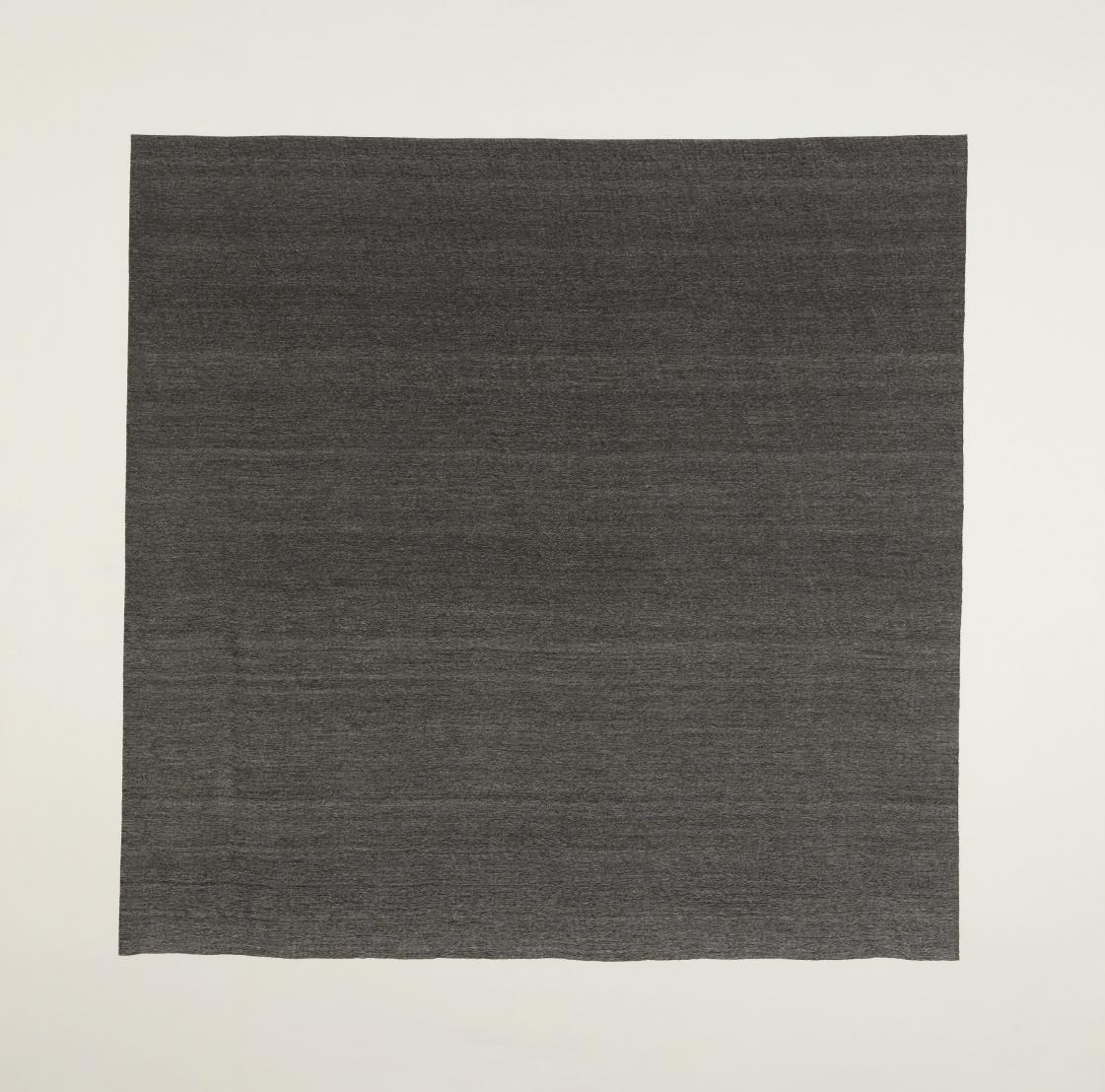
Heraclitus, fragment 12
1.4 mm black rotring ink pen on 300gsm Heritage rag paper, backed onto polyester sailcloth on stretcher
196 x 196 cm
1983